Category: Real Estate & Development

  • From Emerging Concept to $10M+ in Verified Sales

    From Emerging Concept to $10M+ in Verified Sales

    How Stables Motor Condos® helped pioneer, position and commercialize the garage-condominium market in Metro Atlanta.

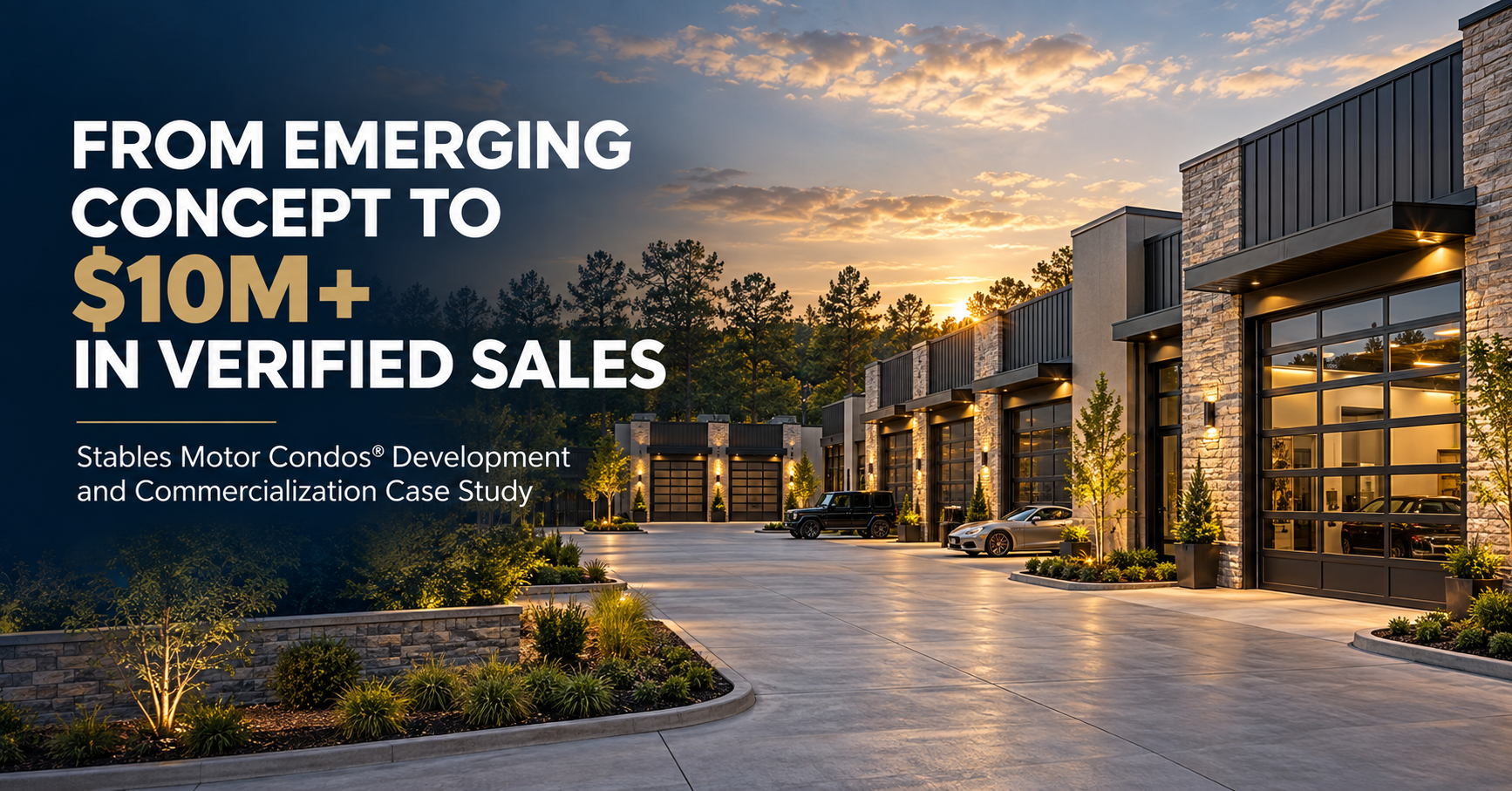
    Rendering of future luxury garage-condominium development for Stables Motor Condos. Development and Sales case study link below.

    THE CHALLENGE

    An Unfamiliar Product in an Emerging Market

    The development question extended beyond construction: Would the market understand, value and purchase the product?

    When Stables Motor Condos® entered the Metro Atlanta market in 2017, garage-condominium ownership was not broadly understood. Jeff Beal and Cindy “Rodeo” Steedle studied the emerging niche, visited other developments and met with industry participants to better understand the product, the buyer and how owners intended to use their spaces. They then faced the challenge of defining the opportunity, educating prospective buyers and creating demand for an emerging real estate category.

    The original Stables development on McFarland Parkway advanced through site control, rezoning, municipal approvals and pre-development planning. However, unforeseen site conditions beyond the team’s control ultimately made the original development path unviable.

    The strategic question became: Could the underlying market opportunity be preserved, repositioned and successfully commercialized on a different site?


    THE STRATEGIC BLUEPRINT

    Preserve the Opportunity and Reposition the Execution Plan

    Stables separated the strength of the market opportunity from the limitations of the original site. The objective was to preserve what had already been created, the market knowledge, brand, buyer relationships and sales infrastructure, and reposition the concept for successful execution.

    1. Research the Niche

    Jeff and Cindy studied comparable garage-condominium developments, visited operating projects, met with other developers and examined how owners intended to use privately owned garage space.

    2. Preserve the Market Thesis

    When the original site became unviable, Stables retained its brand, intellectual property, automotive relationships, buyer intelligence and sales and marketing infrastructure.

    3. Reposition Locally

    Stables used its local market knowledge and municipal relationships to help identify a replacement site and navigate entitlements and approvals.

    4. Create the Development Relationship

    Stables formed a co-development relationship with an out-of-state flex-space developer. The Stables Team contributed local strategy, municipal relationships, entitlement consultancy, design input, trademark licensing, market positioning, demand generation and sales oversight.

    5. Educate Before Selling

    Beginning in 2017, Stables introduced the concept through monthly automotive events, including a featured sponsorship presence at Caffeine & Octane and The Atlanta Concours d’Elegance. Site plans, development renderings and direct conversations helped prospective buyers understand garage-condominium ownership before being asked to purchase.

    6. Build the Buyer Pipeline

    Event engagement, referrals, digital outreach and automotive relationships were converted into a database of more than 700 prospective garage-condominium buyers.


    WHY THE BLUEPRINT WORKED

    Seven Capabilities Connected Development Decisions to the Eventual Buyer

    These capabilities developed through Stables Motor Condos® now form the basis of advisory services for other developers and landowners.

    Market Intelligence

    Tests whether a specialized real estate concept aligns with identifiable buyer demand.

    Site and Municipal Strategy

    Connects location, entitlements, approvals and local relationships to the realities of project execution.

    Product-Market Fit

    Defines the target buyer, intended uses, ownership proposition and value narrative.

    Brand Positioning

    Differentiates the project from commodity storage, conventional flex space and competing developments.

    Market Education

    Builds buyer understanding and trust before asking prospects to make a purchase decision.

    Lead Generation

    Creates a qualified buyer pipeline before construction delivery or conventional listing exposure.

    Sales Strategy

    Connects pricing, inventory communication, buyer follow-up and objection handling to transaction execution.

    The operating principle: Specialized real estate succeeds when the site, product, economics, positioning and sales strategy are developed around the same buyer.


    THE PROOF

    Market Education Converted into Measurable Demand and Sales

    The results reflect years of category research, relationship building, market education and commercialization work.

    2017

    Stables Motor Condos® launched

    700+

    Prospective-buyer database

    18 Months

    Mercedes-Benz USA relationship

    $10M+

    Verified garage-condominium sales during 2024–2025

    Third-Party Brand Validation

    Between 2018 and 2019, Stables maintained an 18-month brand integration and strategic marketing partnership with Mercedes-Benz USA. Mercedes-Benz USA provided Stables with two new marketing vehicles to drive and display at automotive events. The vehicles carried decals identifying Mercedes-Benz USA as the Official Automotive Partner.

    Commercial Validation

    Jeff and Cindy’s market education, lead generation, sales and marketing leadership contributed to more than $10 million in verified garage-condominium sales during 2024–2025. The sales volume is supported by brokerage records and settlement statements.


    FROM PROJECT EXPERIENCE TO DEVELOPER ADVISORY

    Apply the Lessons Before Major Capital Decisions Become Fixed

    The Stables Motor Condos® case study demonstrates a transferable advisory capability—not simply the history of one brand. That experience can help developers and landowners evaluate critical assumptions before committing significant capital.

    Before Acquiring Land

    Evaluate market alignment, buyer concentration, competitive supply, site suitability, municipal considerations and early go-or-no-go factors.

    Before Finalizing the Plan

    Evaluate buyer use cases, product positioning, ownership narrative, unit strategy, pricing assumptions and overall marketability.

    Before Launching Sales

    Develop the brand positioning, lead-generation strategy, presale program, automotive partnerships, buyer education and sales systems.

    When a Project Is Struggling

    Identify problems involving pricing alignment, lead quality, buyer objections, value narrative, market education and sales follow-up.

    Transferable Expertise in Practice

    The expertise developed through Stables is now being applied to independently owned developments. At The Toy Barn of Dillard, Jeff and Cindy provide specialized market positioning, lead generation, buyer education, and sales and marketing services through SERHANT. Georgia.


    DEVELOPMENT ADVISORY

    Considering a Garage-Condominium, Specialized Flex-Space or Automotive Real Estate Project?

    Before committing significant capital to land, design, construction or marketing, confirm that the proposed product aligns with the market and its eventual buyer.

    Jeff Beal and Cindy “Rodeo” Steedle advise developers and landowners across the following areas:

    • Development opportunity assessment
    • Market and competitive analysis
    • Site and product-market-fit review
    • Garage-condo development advisory
    • Brand and go-to-market strategy
    • Presale and lead-generation strategy
    • Sales and marketing representation

    Discuss the opportunity before the site plan, pricing and capital commitments are finalized.

    Download Case Study

  • The Entitlement Blueprint: From Site Control to Rezoning Approval

    The Entitlement Blueprint: From Site Control to Rezoning Approval

    Before a development can become a building, a destination, or an investment opportunity, someone has to establish whether the land can support the vision. That process begins well before construction—with site control, due diligence, feasibility, municipal engagement, and a clear path through zoning and entitlements.


    PROJECT SNAPSHOT

    • Location: McFarland Parkway, Forsyth County, Georgia

    • Project: Original proposed Stables Motor Condos® automotive destination

    • Entitlement: Rezoning from agricultural to M1 and CBD uses, subject to conditions

    • Outcome: Rezoning approved; the original site was later abandoned following a civil-engineering finding


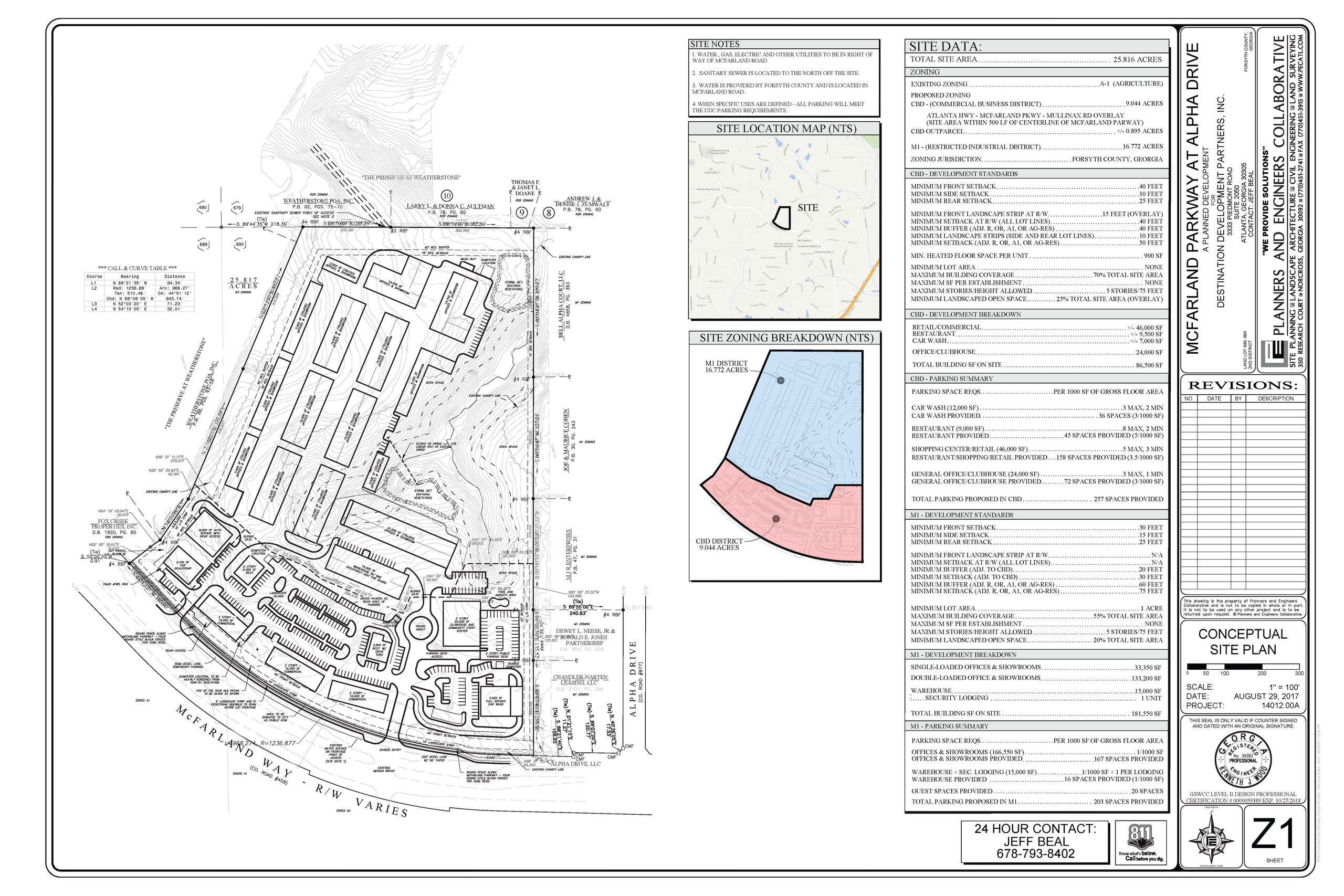
    Conceptual site plan dated October 29, 2017, prepared after the rezoning approval. Proposed uses and layout shown; the project was not constructed at this location.

    My Role: From Development Vision to Entitled Opportunity

    As co-founder of Stables Motor Condos®, I led the original McFarland Parkway project as developer, from initial concept through site control and rezoning approval. I created the overall project vision, shaped the proposed land uses, assembled and coordinated the professional team, and served as a primary liaison with Forsyth County officials. My responsibility was to keep the development strategy, municipal approval process, and commercial objectives aligned as we worked to turn an unconventional automotive real estate concept into an entitled development opportunity.

    I worked across the critical pre-development workstreams: negotiating the path to site control; shaping the proposed development program; coordinating with planning and engineering professionals; engaging Forsyth County officials to understand the approval pathway; and helping align the land-use strategy with the project’s commercial objectives. I also worked to position the opportunity for the capital partner who would acquire the property. These were interconnected decisions—each one affected whether the concept could move from an idea to an entitled development opportunity.

    Site Control Comes Before Site Development

    Securing control of a property does not necessarily mean purchasing it outright. Depending on the opportunity, a developer may use a purchase agreement, option, or other negotiated structure that provides time to evaluate the property before committing substantial capital. The objective is to establish a defined period for due diligence while identifying the conditions that must be satisfied before closing.

    For the original Stables Motor Condos development on McFarland Parkway in Forsyth County, Georgia, our team secured site control on May 15, 2017, when the letter of intent was accepted and the purchase-and-sale agreement was signed. That established the foundation for evaluating the property, developing the site plan, and engaging county officials before the capital partner acquired the land.

    The purchase agreement was structured so that closing would occur within 60 days of receiving full entitlements, which tied the commitment of capital to the entitlement outcome. Pre-development work on the site began in May 2017, several months before Stables Motor Condos® was publicly launched in August 2017.

    From Development Vision to Zoning Strategy

    The McFarland Parkway concept called for more than a collection of private garages. Our proposed development brought together luxury garage condominiums and complementary automotive-oriented commercial uses, creating a destination where owners, businesses, and enthusiasts could connect. Translating that vision into a viable land-use plan required a zoning strategy that addressed the different uses within the proposed development.

    The property’s existing agricultural zoning did not accommodate the full development concept. We worked to align the proposed uses with Forsyth County’s land-use requirements, pursuing a combination of Restricted Industrial (M1) and Commercial Business District (CBD) zoning. This approach allowed the garage-condominium component and proposed commercial amenities to be evaluated as parts of a coordinated development program.

    Municipal Engagement and the Entitlement Process

    Municipal engagement was an essential part of the McFarland Parkway entitlement strategy. Rather than treating rezoning as a standalone application, we presented the proposed development as a coordinated land-use program and worked through the county’s review process to address how its automotive, commercial, and gathering spaces would function together. The objective was to establish a clear path from the property’s existing zoning to an approved development framework.

    Both applications were processed by the county as county-initiated zoning applications. Public hearings were held on October 5, 2017 for ZA3872 and October 19, 2017 for ZA3873. On October 19, 2017, the Forsyth County Board of Commissioners adopted both resolutions: ZA3872 established 9.044 acres of Commercial Business District (CBD) zoning, and ZA3873 established 16.772 acres of Restricted Industrial District (M1) zoning, each subject to development conditions. The approval established a land-use framework for the proposed Stables Motor Condos destination; it did not mean the full development had been constructed.

    Documented Entitlement Result

    The entitlement outcome is documented in two signed Forsyth County Board of Commissioners resolutions, both dated October 19, 2017: ZA3872, approving 9.044 acres for Commercial Business District (CBD) zoning, and ZA3873, approving 16.772 acres for Restricted Industrial District (M1) zoning. Both approvals were subject to development conditions.

    Supporting documents: Forsyth County Board of Commissioners resolutions ZA3872 (CBD) and ZA3873 (M1), adopted October 19, 2017.

    The Conditions of Approval.

    Rezoning approval did not arrive as a blank check. The CBD resolution carried 23 conditions and the M1 resolution carried 27, and together they shaped the project as much as the zoning districts themselves.

    On the CBD side, the conditions called for a modern architectural style transitioning to an equestrian character in the rear, a restaurant with a rooftop design and a coffee shop, a single vehicle dealership with no vehicles shown or sold below $85,000, a parking deck capped at three stories and 200 spaces, and an event center of up to 24,000 square feet made available for six annual fundraising events benefiting organizations supported by the local United Way. On the M1 side, the conditions required barn-inspired garage design, a mandatory owners association, no retail sales or mechanics for hire, and a preserved nature area and park honoring the Herring family. A phasing condition tied the two together: 35% of the retail space had to receive a certificate of occupancy before more than 35% of the garage units. Any change from the approved garage-condominium use would have to return to the Board of Commissioners. Working with county officials and neighbors, we negotiated these conditions as part of a single, coordinated land-use program.

    Beyond Rezoning: Securing a Use Change for the Retail Village

    Entitlement work didn’t stop at the rezoning. In March 2019, the Forsyth County Board of Commissioners took up Public Hearing #14 — a Unified Development Code text amendment adding micro-distillery and brewery use to the list of permitted uses on premises. Several local businesses, including the Stables retail village, had asked the county to make the change.

    I presented presented project and spoke to why the amendment should be approved, alongside the Robert Long, Director of the Forsyth County Development Authority, and Paula Dezzutti, owner of Local Choice Spirits & Striped Pig Distillery, who planned to lease space in the retail village for her new distillery. The Board approved the amendment unanimously.

    Presenting to the Forsyth County Board of Commissioners in support of the UDC amendment, March 2019.

    The Value of an Entitled Development Opportunity

    Rezoning approval can change how a property is evaluated by prospective development partners, investors, and buyers. It replaces some of the uncertainty surrounding permitted uses with an approved land-use framework, subject to the conditions of approval and any remaining permits or requirements. For McFarland Parkway, the entitlement work moved the Stables concept beyond an initial vision and established a more defined development opportunity.

    The Outcome—and the Lesson

    The McFarland Parkway project did not proceed to construction at that site. During the county’s final Technical Site Review Board process, the county determined that a dotted blue line, the mapping notation for an intermittent stream that flows only after rain, ran through the property. It was in a different part of the site from the natural stream and wetlands area we had already identified in an unusable portion of the property and planned to incorporate into the detention and runoff design, and it had not appeared in any study completed before that review. Crossing it would have required a nationwide permit, a retaining wall roughly 100 feet long and 40 feet high, and a structural vehicle bridge, at an estimated cost of about $2 million before any other infrastructure was in place. That was not cost effective, and we chose to release the site.

    For developers and landowners, the lesson is to evaluate zoning, site conditions, infrastructure, and financial feasibility as connected parts of one decision—not as separate milestones. A compelling concept needs both an achievable approval strategy and a property that can support the intended development.

    The structure of the deal carries a lesson as well. Because the purchase agreement tied closing to full entitlements rather than to completed site studies, the wetlands, topographic, and civil engineering work followed the January 2018 closings. That structure managed approval risk well, but it did not resolve physical site risk. On future projects, I treat a feasibility contingency covering those studies as a companion to any entitlement contingency.

    The Financial Outcome: Documented Land Transactions

    The financial significance of the McFarland Parkway project began with the land itself. When we secured site control, the property was agriculturally zoned raw land. I led the effort to establish a development vision and advance the property through the entitlement process, securing M1 and CBD zoning approvals that supported its proposed highest and best use. That work created value by transforming the property from an agricultural land opportunity into an entitled commercial and restricted-industrial development opportunity—before vertical construction began.

    Our capital partner acquired the three parcels in January 2018 under terms I negotiated with the original sellers. The transactions were recorded at $909,000, $909,000, and $3,795,925—a combined acquisition price of $5,613,925. After we determined that our project would not proceed at this location, we released our interest in the site. Our capital partner subsequently sold the property on October 11, 2022, for $8,390,500, a difference of $2,776,575 between the recorded acquisition and sale prices.

    The figures above reflect the capital partner’s recorded transactions. They are gross prices, not a measure of net profit or of returns to any party, and the difference between them should not be attributed to rezoning alone. The lesson is that entitlements can change how a property is evaluated, and that value can be repositioned well before construction begins.

    Download Case Study