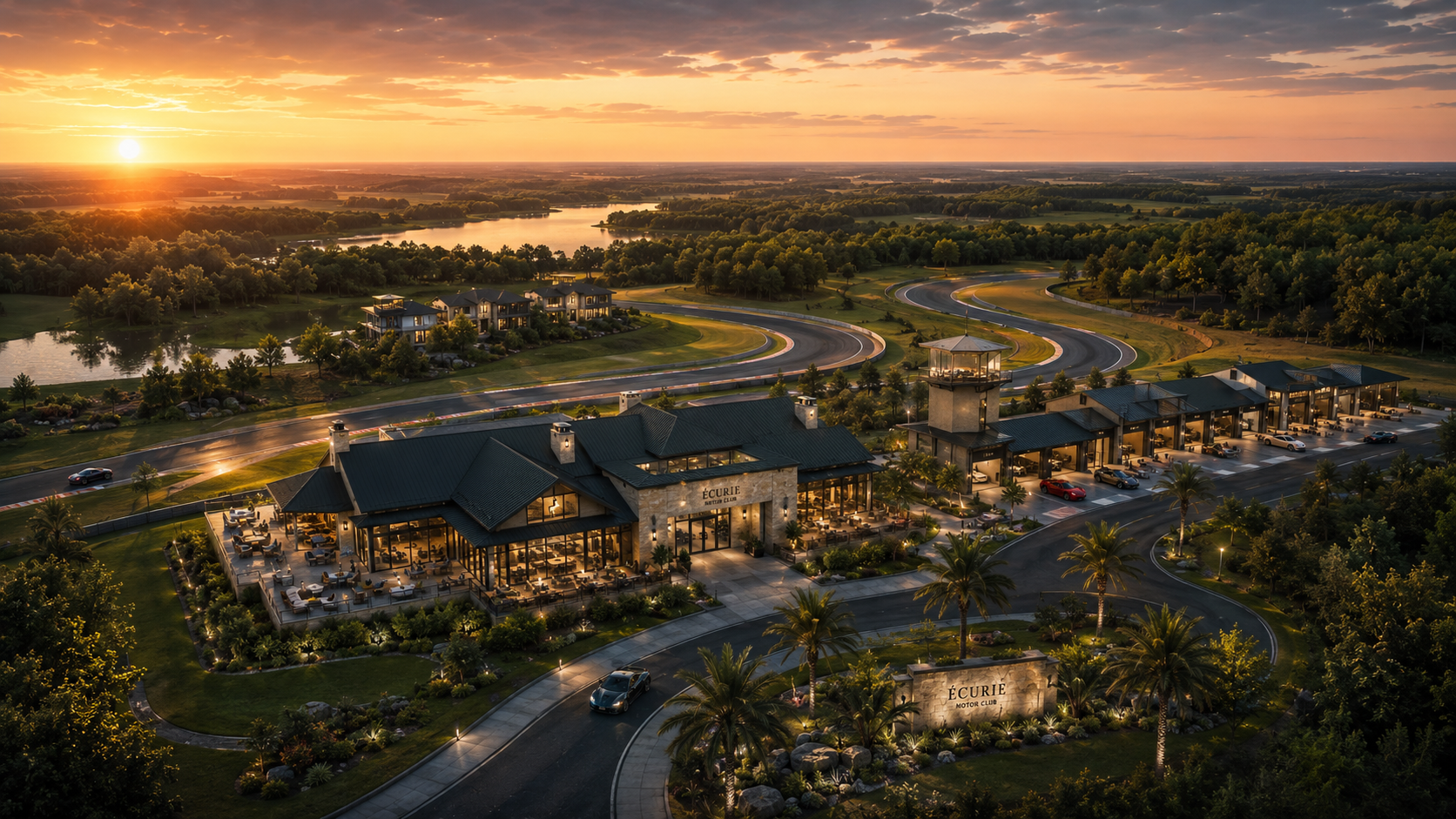
How private motorsports clubs are evolving into diversified automotive lifestyle ecosystems.
A racetrack is an extraordinary asset.
It is also an expensive one.
Miles of specialized pavement, safety systems, barriers, paddocks, garages, buildings, utilities, maintenance infrastructure and professional operating teams require significant capital to build and significant resources to operate.
For decades, the traditional racetrack business largely revolved around monetizing that infrastructure through race weekends, track rentals, spectator events, sponsorships and driving programs.
But a different model is emerging across the private motorsports sector.
The track remains the centerpiece.
It is no longer necessarily the entire business.
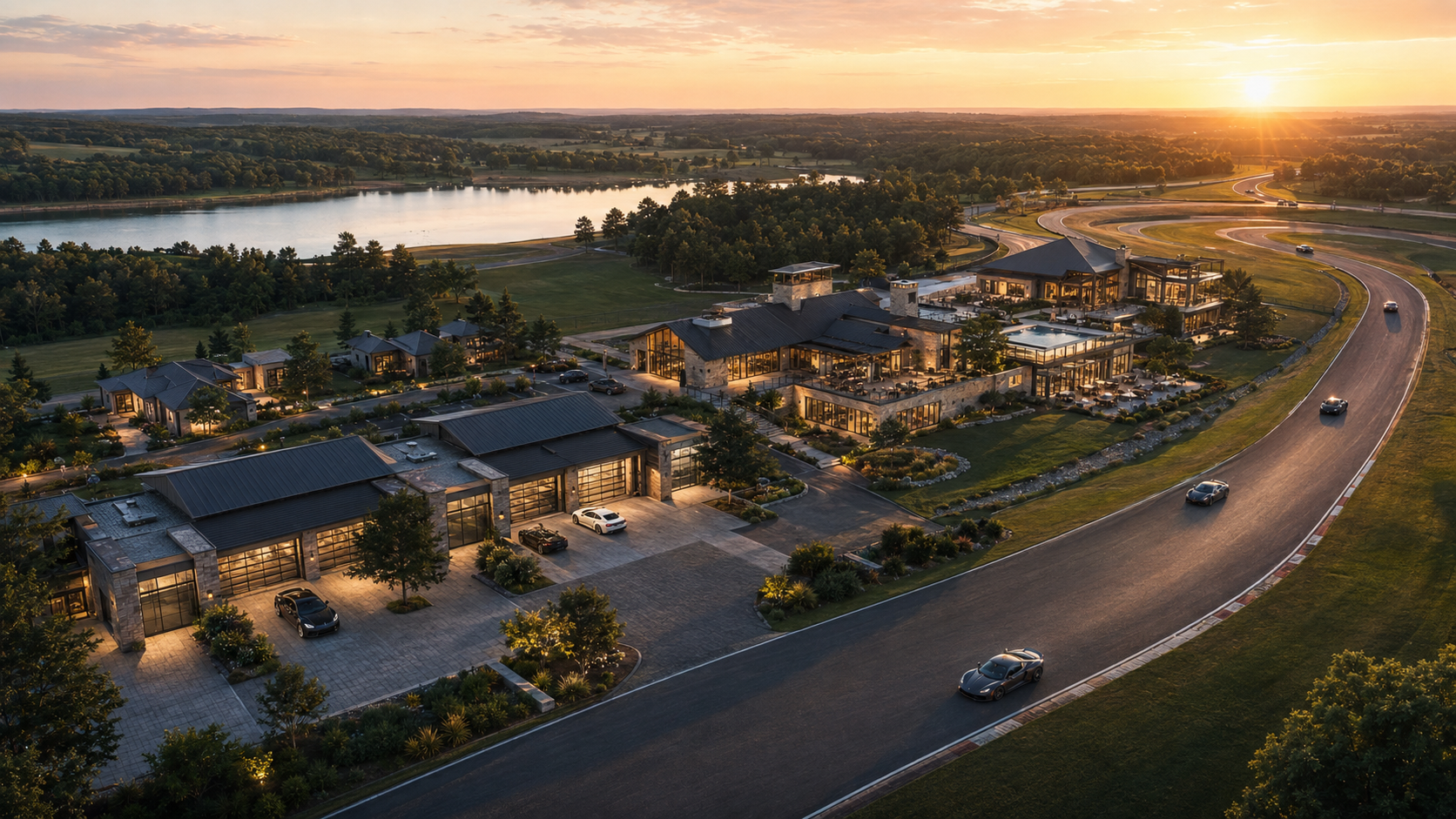
Increasingly, private motorsports developments are combining membership, real estate, hospitality, automotive services, driving experiences, corporate events, commercial activity and community into a single interconnected ecosystem.
That evolution may ultimately prove to be one of the most important developments shaping the future of private motorsports in America.
From Track Utilization to Ecosystem Economics
The traditional racetrack faces a fundamental economic constraint:
There are only so many usable track days in a year.
Weather, maintenance, noise restrictions, racing calendars, testing schedules and operational requirements all place limitations on how frequently a circuit can generate revenue.
That makes utilization extraordinarily important.
But the next generation of private motorsports developments is approaching the challenge differently.
Instead of asking only:
“How do we generate more revenue from the racetrack?”
The more interesting question becomes:
“What businesses, experiences and assets can exist because the racetrack is here?”
That distinction changes everything.
Mücke Roth & Company identified this diversification directly in its analysis of the U.S. motorsports industry. The firm argues that expanding the revenue mix will be critical to the future of the racetrack business, specifically pointing to real estate, garages, OEM partnerships, corporate events, driving experiences, vehicle services and other complementary offerings.
The result is a business model that can look increasingly less like a standalone sporting venue and more like a destination ecosystem.
- Membership Creates the Foundation
At the center of the private-club model is membership.
Membership fundamentally changes the relationship between a customer and a racetrack.
A traditional track customer may attend an event several times each year.
A member belongs to the property.
That distinction creates recurring engagement and, depending on the club structure, recurring dues or other membership-related revenue.
But membership does something else that is equally important.
It creates a built-in community around which additional products and services can be developed.
Members may need:
- Vehicle storage
- Track preparation
- Maintenance
- Fuel
- Tires
- Coaching
- Dining
- Hospitality
- Guest experiences
- Garage space
- Overnight accommodations
- Social programming
- Family activities
Each requirement represents another layer of the ecosystem.
The membership business therefore becomes more than access to pavement.
It becomes the gateway into a much broader relationship with the property.
- Real Estate Changes the Economics
One of the most significant developments in private motorsports has been the integration of real estate.
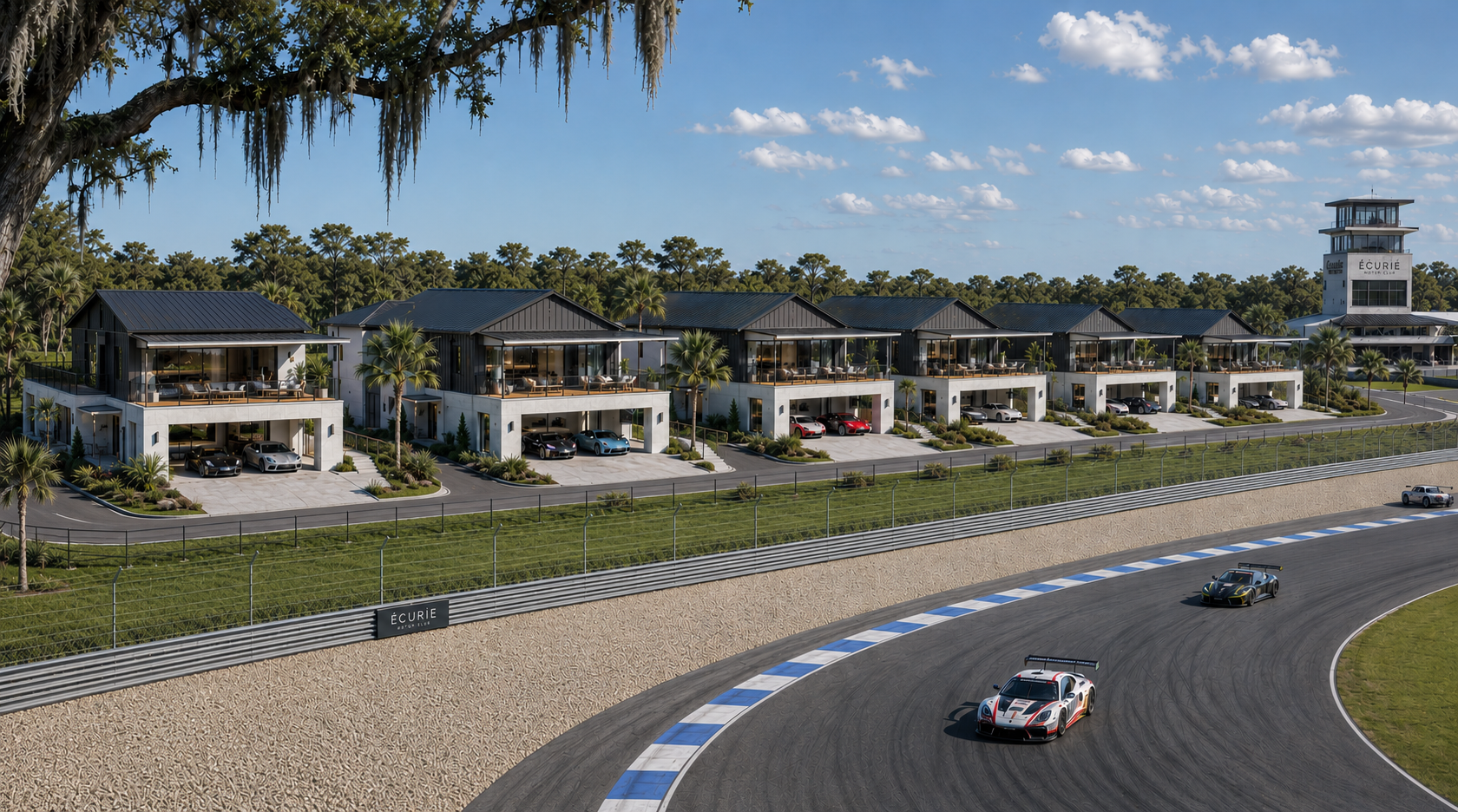
Garage condominiums, trackside villas, private residences and garage townhomes can serve several purposes simultaneously.
They provide enthusiasts with a place to store and enjoy their automobiles.
They allow members to spend more time at the property.
They create another form of attachment to the club.
And from a development perspective, they introduce an entirely separate economic component from track operations.
The Thermal Club in California demonstrates how deeply the two can be integrated. Its 426-acre community combines private racing circuits with custom homes, villas and homesites designed around the motorsports environment.
P1 Motor Club in Florida is pursuing a similar concept at a different scale. Its members can purchase trackside garage townhomes or residences, with the garages designed to combine substantial automotive storage with residential living areas overlooking the circuit.
The Motor Enclave in Tampa illustrates another variation. Its 200-acre campus includes more than 300 private luxury garages alongside its performance circuit, off-road facilities and event center.
These examples point toward an important shift.
Automotive real estate is becoming part of the motorsports product itself.
The garage is no longer simply somewhere behind the paddock where a car is stored.
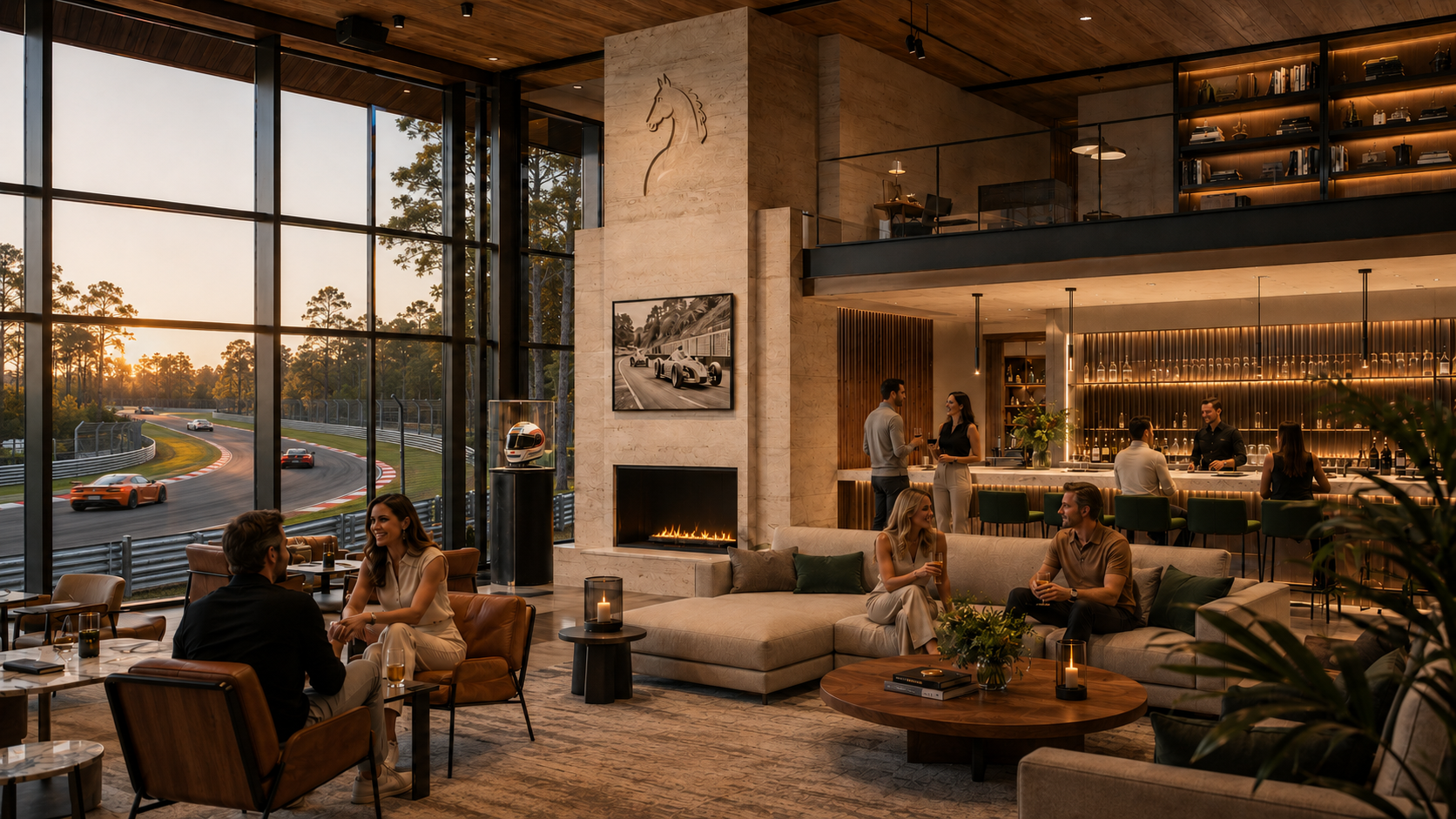
In many developments, it becomes a social space, entertainment venue, collection gallery, office, clubhouse extension or second home.
That changes the relationship between member and property from occasional visitor to invested stakeholder.
- Hospitality Extends the Experience Beyond Driving
A member may spend several hours driving.
What happens during the rest of the day?
That question is helping reshape private motorsports developments.
Dining, clubhouses, pools, wellness facilities, lounges, accommodations and social programming extend the useful life of a member visit far beyond track sessions.
At The Thermal Club, the experience now includes dining, resort-style pools, wellness and spa services, fitness facilities, tennis, pickleball and family programming in addition to motorsports.
Monticello Motor Club similarly combines its circuit with dining, a member clubhouse, trackside accommodations, vehicle services, private garages, a collector-car gallery and karting.
This is strategically important because a private club is ultimately competing for something more valuable than a member’s money.
It is competing for the member’s time.
The more reasons members have to remain on property—and to bring spouses, children, friends, clients and business associates—the more meaningful the club becomes in their lives.
At that point, the business has moved beyond track access.
It has entered hospitality.
- Automotive Services Remove Friction
Anyone who has participated seriously in track driving understands that the driving itself may be the simplest part of the experience.
Cars must be transported.
Tires wear.
Fuel is consumed.
Fluids need to be checked.
Brake pads need replacement.
Vehicles require preparation, inspection and maintenance.
For members with demanding businesses and limited free time, those logistical requirements can quickly become obstacles.
Leading private clubs increasingly address this by providing services directly on property.
Monticello Motor Club operates a 17,000-square-foot race shop and offers maintenance, upgrades, repairs, vehicle storage and private garages. Its model is designed so members can effectively arrive and drive rather than manage every logistical detail themselves.
The Thermal Club similarly offers vehicle preparation, maintenance support, secure storage, detailing, fueling, engineering services and professional driver instruction.
This illustrates another important principle of luxury businesses:
Convenience is part of the product.
The member is not necessarily buying only track time.
The member may be buying the ability to enjoy motorsports without having to personally manage every operational detail required to participate.
- Corporate Events Open an Entirely Different Market
The person driving on Saturday may be a club member.
The company entertaining clients on Tuesday may be an entirely different customer.
Corporate events represent another major opportunity for diversified motorsports venues.
Product introductions.
Dealer meetings.
Executive retreats.
Client entertainment.
Team-building programs.
Brand activations.
Private driving experiences.
Automotive manufacturers and corporations are constantly searching for memorable environments in which to engage customers, employees and partners.
A motorsports facility offers something conventional ballrooms and conference centers cannot easily reproduce:
experience.
The Motor Enclave has built this concept directly into its development. In addition to its 1.72-mile Tilke-designed circuit and private garage community, the Tampa property contains a 42,000-square-foot event center capable of accommodating functions ranging from small executive meetings to large events, with driving activities integrated into corporate programming.
This creates utilization even when members are not occupying the circuit.
It also introduces the property to people who may never have previously considered joining a motorsports club.
Today’s corporate guest can become tomorrow’s member, garage owner, sponsor or strategic partner.
- OEM Relationships Can Create Another Layer of Utilization
Automotive manufacturers have requirements that align naturally with purpose-built driving environments.
They need places for:
- Product demonstrations
- Vehicle testing
- Dealer education
- Customer experiences
- Media events
- Performance driving programs
- Technology demonstrations
- Engineering activity
- Executive hospitality
Mücke Roth specifically identifies OEM partnerships, sponsorships and driving-experience centers as increasingly relevant components of the evolving racetrack business model, in part because they can contribute to baseline facility utilization.
The importance of this relationship extends beyond revenue.
An OEM presence can add credibility, programming, technical expertise and industry connectivity to a motorsports development.
It can also help reposition a racetrack from being solely a recreational venue into something closer to automotive infrastructure.
That distinction will likely become increasingly relevant as mobility technology continues evolving.
- Commercial Development Can Create an Automotive Business Ecosystem
One of the most interesting extensions of the model may be the creation of commercial automotive districts around private circuits.
Race teams need facilities.
Performance shops need facilities.
Driving schools need facilities.
Automotive technology companies need testing environments.
Vehicle storage businesses need customers.
Engineering firms benefit from access to real-world testing.
These businesses can become more valuable when they are physically located beside the customers, cars and infrastructure they serve.
P1 Motor Club provides a particularly clear example.
Its planned Commerce Park provides up to 400,000 square feet of space intended for motorsports and automotive businesses including race teams, engineering organizations and related operators. P1 says more than half of that space has already been reserved, and the development offers businesses proximity to the circuit, customers and test-and-tune opportunities.
This introduces another fascinating possibility.
A private motorsports development can potentially create its own business cluster.
Members generate demand.
Automotive businesses provide services.
Teams and technical companies provide expertise.
The racetrack provides testing infrastructure.
Events bring visitors.
Real estate keeps people on property.
Hospitality creates gathering places.
Each part makes the other parts more useful.
That is the definition of an ecosystem.
- Experiences Expand the Addressable Audience
Not everyone interested in motorsports is ready to purchase a track car or join a private club.
That does not mean they are irrelevant to the business.
Karting.
Driving schools.
Performance-driving experiences.
Defensive-driving programs.
Simulators.
Manufacturer experiences.
Special events.
Corporate programs.
These activities provide lower-barrier entry points into the motorsports environment.
The Motor Enclave, for example, offers driving experiences ranging from introductory track programs to advanced sessions, off-road experiences and driver education in addition to its private membership and garage ownership offerings.
Monticello incorporates karting alongside its private club activities, including programs for younger drivers and families.
That matters because the future member may not begin as a member.
They may begin as a corporate guest.
A driving-school participant.
A karting parent.
An event attendee.
A manufacturer guest.
Or someone invited by an existing member.
A diversified facility creates multiple doors through which someone can enter the community.
The Power Is in the Flywheel
Individually, each of these businesses can generate value.
Together, they can become considerably more powerful.
Consider the relationship:
Membership creates community.
Community creates demand for garages and real estate.
Real estate increases time spent on property.
More time on property increases demand for hospitality and services.
Services attract automotive businesses.
Automotive businesses create technical capability.
Technical capability attracts manufacturers and racing organizations.
Corporate and manufacturer activity increases facility utilization.
Events introduce new people to the property.
Those experiences create future members, customers and partners.
And the cycle begins again.
That is the economic flywheel behind the emerging automotive lifestyle ecosystem.
It does not mean every private motorsports development should include every possible component.
Nor does diversification guarantee financial success. Projects of this scale remain capital-intensive, operationally complex and dependent upon market demand, execution and location.
But the underlying principle is becoming increasingly clear:
The more ways a property can create value around motorsports, the less dependent it may be on monetizing the racetrack alone.
The Track Becomes the Anchor
This may ultimately be the most important distinction.
The racetrack remains essential.
It creates the identity.
It creates the excitement.
It creates the reason enthusiasts initially pay attention.
It provides something that cannot be recreated inside a conventional country club, resort or real estate development.
But economically, the track may increasingly function much like another powerful development anchor.
A golf course anchors a golf community.
A marina anchors a waterfront community.
A ski mountain anchors a mountain resort.
And a world-class circuit can anchor an automotive community.
Around that anchor can emerge residences, garages, hospitality, services, businesses, events and experiences.
The pavement creates the gravitational pull.
The ecosystem creates the destination.
The Next Generation of Motorsports Development
The private motorsports industry is still relatively young compared with traditional golf, resort and country-club development.
Its models will continue to evolve.
Some facilities will emphasize driving.
Others will emphasize luxury.
Some will build heavily around real estate.
Others may focus on corporate events, manufacturers, racing organizations or automotive businesses.
The strongest projects may ultimately combine several of these elements in ways uniquely suited to their markets.
What is becoming increasingly evident, however, is that the conversation about private motorsports can no longer focus exclusively on circuit length, corner count or horsepower.
Those things will always matter.
But the larger business conversation now includes:
Membership.
Real estate.
Hospitality.
Automotive services.
Corporate experiences.
OEM relationships.
Commercial development.
Community.
The racetrack may bring people through the gate.
What surrounds it may determine how often they return, how long they stay and how deeply they become connected to the place.
That is why the future of the private motorsports club may ultimately be defined by something much bigger than the track itself.
The track is the anchor.
The ecosystem is the business.
Sources and further reading: Mücke Roth & Company, “The Evolution and Future of the U.S. Motorsport Industry”; The Thermal Club; Monticello Motor Club; The Motor Enclave; and P1 Motor Club.