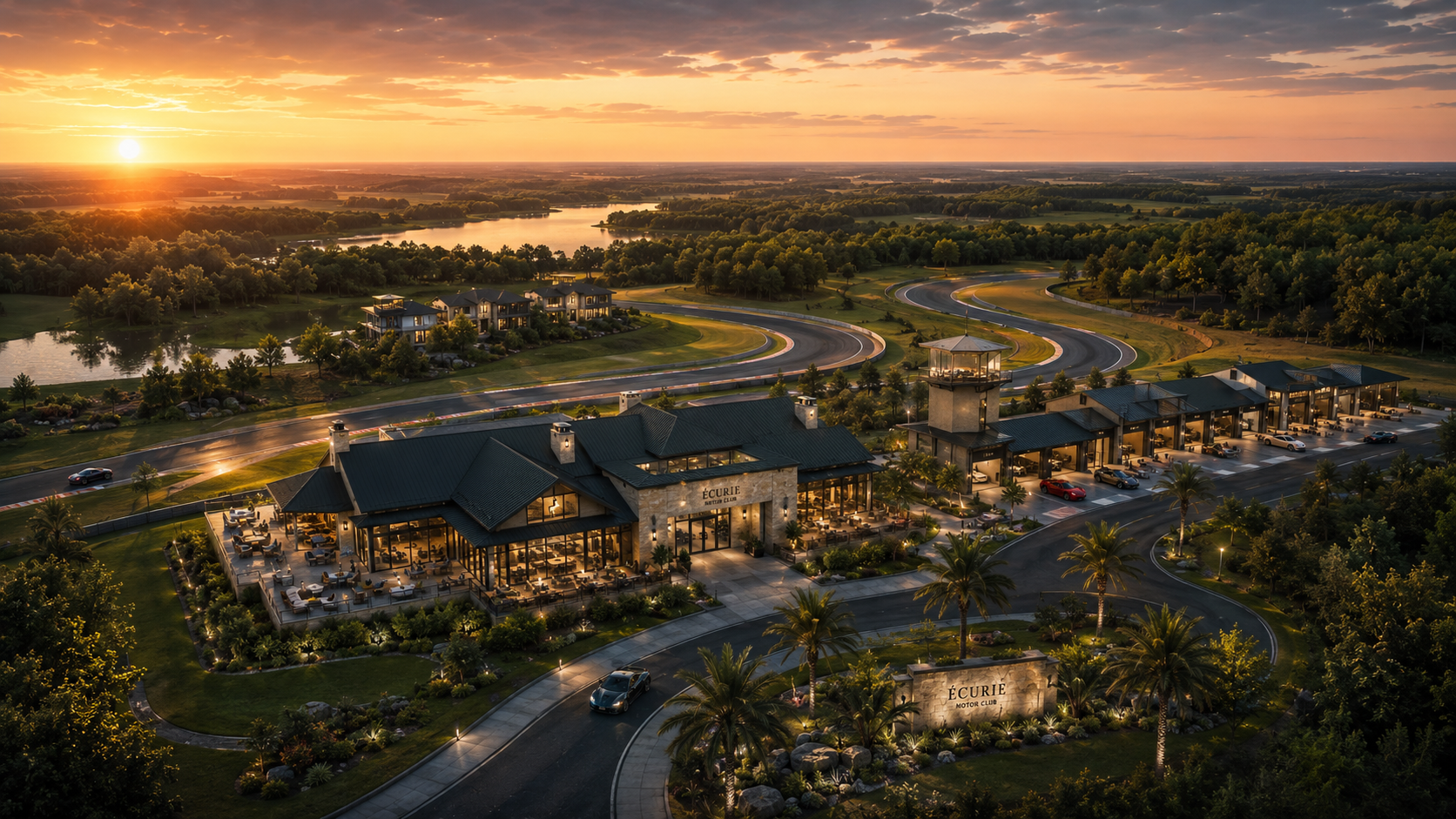
The private motorsports industry is entering a new chapter — one defined not simply by where enthusiasts drive, but by where they gather, belong, live, entertain and experience automotive culture.
For generations, the American country club has been built around a familiar centerpiece: the golf course.
Today, another model is emerging.
Across the United States, a growing number of private motorsports clubs and automotive lifestyle destinations are bringing together high-performance driving, hospitality, private garages, residences, professional instruction, corporate experiences and social communities around a very different centerpiece:
The racetrack.
What was once a relatively small niche within American motorsports is increasingly attracting the attention of developers, investors, automotive manufacturers and enthusiasts alike.
And there is good reason to believe this represents something larger than a passing trend.
It may represent the next evolution of the American motorsports business.
From Racetrack to Lifestyle Ecosystem
Traditional racetracks were generally built around racing.
They hosted sanctioned competition, club racing, track days, driver education and spectator events. Their economics depended heavily on event calendars, track rentals, sponsorships, admissions and racing activity.
Private motorsports clubs introduced a fundamentally different proposition.
Instead of asking enthusiasts to visit a racetrack occasionally, they created a place for those enthusiasts to belong.
Membership changed the relationship.
The track became an amenity within a larger community.
Today, the most ambitious projects are taking that concept even further.
Private motorsports developments increasingly combine:
- Membership
- Performance driving
- Driver development
- Karting and other driving experiences
- Private garages and automotive storage
- Trackside residences
- Clubhouses and hospitality
- Restaurants and social spaces
- Vehicle service and concierge programs
- Corporate entertainment
- Manufacturer events and vehicle launches
- Testing and research environments
- Family amenities
- Special events and enthusiast programming
That diversification matters.
Mücke Roth & Company noted in its analysis of the U.S. motorsports industry that the long-term racetrack business model is increasingly expanding beyond track utilization into real estate, corporate partnerships, driving experiences and other complementary revenue streams.
In other words, the business is no longer simply about monetizing pavement.
It is about creating an ecosystem around it.
The Automobile Itself Has Changed
There is another powerful force behind the growth of these facilities:
The cars have outgrown the roads.
Modern performance automobiles routinely deliver levels of acceleration, braking, aerodynamics and horsepower that would have been considered extraordinary even among purpose-built race cars several decades ago.
For owners of these vehicles, public roads offer increasingly limited opportunities to experience what the automobile was engineered to do.
The Wall Street Journal recently highlighted the relationship between private racetrack demand and the changing collector-car market. Citing Hagerty data, the Journal reported that approximately 2,400 vehicles sold at global auctions for $1 million or more between 2016 and 2025, compared with approximately 1,350 from the early 1980s through 2015. Even more telling, cars less than 20 years old recently represented the largest share of that million-dollar-plus auction market for the first time.
That distinction is important.
Many of today’s collectible cars are not simply objects to display.
They are machines their owners want to experience.
A 1,000-horsepower hypercar sitting inside a climate-controlled collection may be valuable.
But increasingly, the owner also wants a place to drive it, learn its capabilities, share the experience with friends and interact with other people who understand the same passion.
That represents a shift from automotive ownership toward automotive participation.
Private motorsports clubs sit directly at that intersection.
Experience Is Becoming as Important as Exclusivity
Luxury itself is changing.
The traditional definition of luxury often centered around possession: the home, the yacht, the automobile, the watch or the club membership.
Increasingly, the value proposition includes something else:
Access to experiences that cannot easily be replicated elsewhere.
A private motorsports club can provide precisely that.
It can offer a member the ability to arrive, have a vehicle prepared and waiting, receive professional coaching, spend time on a purpose-built circuit, meet friends for lunch, conduct a business conversation, participate in a club event and return home without dealing with much of the logistics normally associated with a traditional track day.
The best facilities remove friction from the enthusiast experience.
The Thermal Club in California illustrates how far that idea can extend. Across 426 private acres, the development integrates more than five miles of private pavement with residences, garages, dining, pools, wellness amenities, driver development and vehicle services.
The Concours Club in Miami similarly combines a private two-plus-mile driving circuit with dining, vehicle storage, garages, performance vehicles, event facilities, service, detailing and recreational amenities.
These aren’t simply better racetracks.
They represent a different product category.
Real Estate Is Becoming Part of the Motorsport Business Model
Perhaps one of the most significant developments in the sector is the integration of real estate.
The connection is logical.
Enthusiasts with valuable automotive collections need space.
Track users value convenience.
Members traveling from another market may want accommodations.
Collectors want environments where automobiles can be displayed, maintained and enjoyed.
Developers want revenue streams capable of supporting significant infrastructure investment.
Bring those interests together and the private garage, trackside residence or automotive condominium becomes more than an ancillary product.
It becomes part of the economic engine of the development.
The Motor Enclave in Tampa is one of the clearest examples. Its 200-acre campus combines a 1.72-mile Tilke-designed performance circuit, off-road facilities, an event center and more than 300 private luxury garages.
The Thermal Club integrates luxury residential development directly with its circuits.
And P1 Motor Club, currently being developed in Florida’s St. Lucie County, is taking the model to another scale entirely.
Its 663-acre plan includes more than nine miles of driving circuits, trackside residences, garage townhomes, a members’ clubhouse, karting, rally and drift facilities, event infrastructure and a separate commerce park supporting motorsports-related businesses.
The significance is difficult to miss.
Motorsports, hospitality and real estate are beginning to converge into a single development model.
The Clubhouse May Matter Almost as Much as the Circuit
There is another lesson that traditional country clubs understood long ago.
People may initially join because of the activity.
They often stay because of the relationships.
Golf provides the common interest, but the clubhouse creates community.
Private motorsports clubs operate on a similar principle.
The automobile becomes the catalyst.
Members arrive because they love cars, driving and motorsports. Over time, however, relationships form between entrepreneurs, executives, collectors, professionals, racers, manufacturers and families who share those interests.
The paddock becomes a social environment.
The garage becomes a gathering place.
Dinner follows the final driving session.
Families begin participating.
Business relationships form organically.
And the value of membership gradually extends well beyond track access.
That is why the most successful future motorsports clubs may not necessarily be those with the longest straightaway or the most technically demanding corner sequence.
Those things matter enormously.
But the enduring competitive advantage may come from something harder to engineer:
community.
A Broader Platform for the Automotive Industry
Private motorsports parks also create opportunities far beyond individual membership.
Automotive manufacturers need environments for:
- Vehicle testing
- Dealer training
- Product demonstrations
- Media launches
- Customer experiences
- Performance driving programs
- Technology development
- Corporate hospitality
Monticello Motor Club, for example, markets its 4.1-mile facility for press launches, consumer events, dealership training and other automotive programs in addition to its member activities.
P1’s development plans similarly include facilities capable of serving manufacturers, race teams, car clubs, corporate events and motorsports-related commercial users.
This introduces an important economic distinction.
A well-designed private motorsports development does not necessarily depend upon a single customer.
Members may use the property one way.
Manufacturers may use it another.
Corporate groups may use it another.
Driving schools, racing programs, hospitality guests, real estate owners and commercial tenants may each interact with different parts of the same ecosystem.
That creates the possibility of a significantly more resilient operating model than a facility dependent primarily upon race weekends or track rentals.
Even Historic Racetracks Are Adopting the Model
Perhaps one of the strongest indications of where the category is heading can be found at Willow Springs International Raceway in California.
Rather than replacing its motorsport heritage, new ownership is investing in it.
Singer Vehicle Design and CrossHarbor Capital Partners acquired the historic facility and have begun repositioning Willow Springs as a broader motorsports destination while maintaining public racing activity.
Part of that transformation includes the Singer Drivers Club, an exclusive membership experience offering multiple circuits, professional coaching, hospitality and automotive programming.
That development is particularly interesting because it demonstrates two paths for the industry.
One is greenfield development: building a purpose-designed motorsports community from the ground up.
The other is reinvention: taking an established racing property and adding hospitality, membership, real estate or lifestyle components capable of supporting its next chapter.
Both models may become increasingly important.
What Comes Next?
The future private motorsports park will likely be difficult to describe using any single traditional real estate or motorsports category.
Is it a racetrack?
Yes.
But it may also be a country club.
A hospitality destination.
A residential community.
An automotive business park.
A corporate experience center.
A training facility.
A vehicle-development environment.
An event venue.
A social community.
And perhaps that is precisely why the category is gaining momentum.
Mücke Roth’s industry analysis identified private racetracks as one of the notable trends shaping the future of American motorsports and emphasized the importance of diversified revenue models, real estate, OEM partnerships and digital experiences.
Recent national coverage from both The Wall Street Journal and The New York Times has now brought broader attention to the same phenomenon.
Meanwhile, established facilities are expanding, historic tracks are being reinvented and new projects are entering development.
Together, those signals point toward something larger.
Private motorsports clubs are moving from the periphery of automotive culture toward becoming an increasingly important part of its infrastructure.
And as performance automobiles become more capable, experiential luxury becomes more important, enthusiast communities become more connected and developers discover ways to integrate hospitality, real estate and automotive experiences, the opportunity will likely continue to evolve.
For more than a century, the golf course helped define the private club.
The next generation may increasingly find its community somewhere very different:
at the racetrack.
Sources and further reading: Mücke Roth & Company, “The Evolution and Future of the U.S. Motorsport Industry”; The Wall Street Journal, “Not Your Father’s Country Club: Here Come the Private Racetracks”; The New York Times, “The Rise of Racetrack Country Clubs: ‘Racing Is Golf on Steroids’”; and current materials from P1 Motor Club, The Thermal Club, The Concours Club, The Motor Enclave, Monticello Motor Club and Singer Drivers Club.